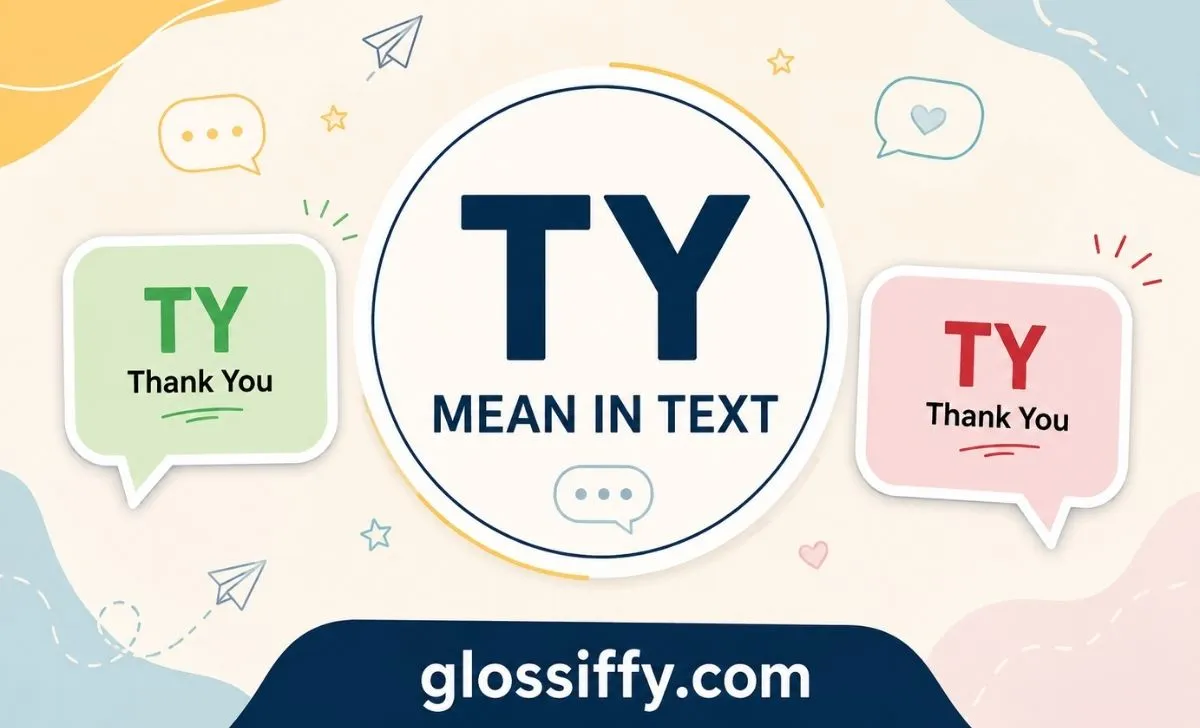
When someone replies with just “ty” after you help them, send them something, or answer a question, the meaning is usually simple. TY means “Thank You.”
It is a short, informal way to show appreciation in text messages, online chats, gaming conversations, and social media.
The lowercase “ty” and uppercase “TY” generally carry the same meaning. However, the tone can change depending on the situation.
In this guide, you’ll learn what TY means in text, how people use it, what it sounds like, how to reply, and when a longer “thank you” may be better.
Quick Answer
TY usually means “Thank You” in text. People use it as a quick way to show appreciation when someone helps them, shares information, gives them something, or does a favor.
It is polite and friendly, but usually more casual and brief than writing the full phrase “Thank you.”
Key Takeaways
- TY means “Thank You” in texting and online chats.
- It is an informal abbreviation used to express gratitude.
- You may see ty, TY, or ty!
- Emojis and extra words can make it sound warmer.
- It is best for casual communication rather than formal writing.
What Does TY Mean in Text?
TY stands for “Thank You.”
It is an initialism used in digital communication. Instead of typing the two words, people use their first letters to create a quick reply.
For example:
“I sent you the notes.”
“ty!”
The second message simply means:
“Thank you!”
TY is common because it is quick to type and easy to understand. It can appear in text messages, DMs, group chats, gaming chats, and social media conversations.
How People Actually Use TY in Texts
People normally use TY after receiving something helpful or kind.
Common situations include:
- Someone answers a question.
- A friend sends a file or link.
- Someone gives you advice.
- A person helps you with a task.
- Someone gives you a compliment.
- Another player helps you in a game.
- Someone provides information you needed.
For example:
“Here’s the address.”
“TY!”
Here, TY simply acknowledges the information and shows appreciation.
You can also make it warmer:
“ty 😊”
or:
“TY so much!”
The basic meaning stays the same, but the extra words or emoji can make the message feel more enthusiastic.
Real Texting Examples of TY
Example 1: Friends
Alex: “I’ll send you the homework notes.”
Sam: “ty!”
Meaning: Sam is thanking Alex for sending the notes.
Example 2: Group Chat
Mia: “Here’s the link to the event.”
Lena: “TY, I was looking for this.”
Meaning: Lena appreciates the useful link.
Example 3: Gaming
Player 1: “I dropped some supplies for you.”
Player 2: “ty bro!”
Meaning: The player is thanking the other person for the supplies.
Example 4: Social Media
“TY for the kind comment ”
Meaning: The person is showing appreciation for the comment.
Example 5: Casual Conversation
“Got the file, ty.”
Meaning: The sender received the file and is briefly saying thank you.
What Tone Does TY Have?
TY is normally casual, polite, and friendly.
However, its tone can depend on the rest of the conversation.
Compare these:
“TY ”
This sounds warm and friendly.
“ty”
This sounds simple and relaxed.
“TY!!!”
This can show stronger excitement or appreciation.
But a short TY can sometimes feel a little dry if the situation calls for a more thoughtful response.
For example, if someone spends hours helping you solve an important problem, replying only “ty” might feel less appreciative than saying “Thank you so much for helping me.”
So, the abbreviation itself is not rude. Context determines how it feels.
TY vs. Similar Texting Abbreviations
| Term | Meaning | Main Difference |
| TY | Thank You | Short expression of gratitude |
| TYSM | Thank You So Much | Stronger appreciation |
| TYVM | Thank You Very Much | More emphatic thanks |
| THX | Thanks | Casual alternative to thank you |
| YW | You’re Welcome | Common response to TY |
TY is the simplest option. If you want to express stronger gratitude, TYSM or TYVM may be more suitable.
How to Reply When Someone Sends TY
You usually do not need a complicated response.
Casual Reply
“Np!”
Friendly Reply
“Anytime!”
Warm Reply
“You’re welcome ”
Short Reply
“Ofc!”
Helpful Reply
“No problem, glad I could help!”
If the conversation is already ending, you may not need to respond at all.
Is TY Used on Social Media?
Yes. TY can be used across many informal digital platforms, including text messages, social media chats, comments, gaming conversations, and group chats. Its basic meaning generally remains “Thank You.”
You might see:
“TY for sharing!”
“tysm!”
“TY ”
“TY for the follow!”
The platform usually does not change the core meaning. The surrounding message mainly affects the tone.
When Should You Use TY — and When Should You Avoid It?
TY is suitable for:
- Friends
- Family
- Casual texting
- Group chats
- Gaming
- Social media
- Informal DMs
Avoid using it when a formal or professional tone is expected, such as:
- Formal emails
- Academic writing
- Official letters
- Business documents
- Important professional communication
Instead, write “Thank you” in those situations.
For example, in a professional email:
“Thank you for your assistance.”
is usually better than:
“TY for your help.”
Common Mistakes With TY
One common mistake is thinking TY is a completely different slang term. In ordinary texting, it simply means “Thank You.”
Another mistake is assuming that lowercase and uppercase forms have different meanings.
TY = Thank You
ty = Thank You
The capitalization usually does not change the meaning.
You should also avoid assuming that a short TY is automatically cold or rude. Some people naturally use short messages even when they genuinely appreciate something.
Is TY Still Used in 2026?
Yes. TY remains a recognized and commonly used texting abbreviation for “Thank You.” Current references continue to list it as internet slang and text-message shorthand.
It is especially useful in quick, informal conversations where people want to acknowledge help without typing the full phrase.
FAQs
What does TY mean in text?
TY means “Thank You.” It is a short and informal way to express gratitude in text messages, chats, and online conversations.
Is TY slang?
TY is commonly treated as internet or texting slang, although technically it is an initialism used as shorthand for “Thank You.”
Is TY rude?
No. TY is normally polite and friendly. However, because it is very short, it can sometimes feel less warm than a full “Thank you,” depending on the situation.
What does ty mean from a girl or guy?
Usually, it simply means “Thank You.” It does not automatically have a romantic or flirty meaning. The surrounding conversation and relationship matter more than the abbreviation itself.
How do I reply to TY?
You can reply with “You’re welcome,” “No problem,” “Anytime,” or “Of course.” In casual chats, a short response is perfectly fine.
What is the difference between TY and TYSM?
TY means “Thank You,” while TYSM means “Thank You So Much.” TYSM expresses stronger appreciation.
Key Takeaway
TY means “Thank You” in text. It is a simple, casual abbreviation used to show appreciation after someone helps, shares information, gives a compliment, or does a favor. Its tone is usually friendly and polite, although a very short reply can sometimes feel less warm. Use TY freely in casual chats, but write “Thank you” when you need a formal or professional tone.
Related Articles

Hi, I am Sajjad Haider, an experienced English teacher with over 10 years of experience teaching English at the high school level. I help students understand English grammar, vocabulary, word meanings, slang, and everyday communication in a simple and practical way.
At Glossiffy.com, I share clear and easy-to-understand explanations of English words, phrases, and meanings to help students, English learners, and everyday readers improve their English with confidence.